
Chapter 22
Using and Understanding a Scott Catalogue
This is a reference chapter. If you need to use a Scott Catalogue, and you have never used one before, this chapter may help you figure it out.
Note: As of 2012, Scott has started releasing Catalogues as Apps for certain smartphones.
22.1 General notes
First of all, a few general notes are in order:
1. Scott spells the word catalog as “Catalogue” in referring to the name of their publication. I use the term “Scott Catalogue” when referring to the specific title of their books. Otherwise, I just use “Scott catalog” as a general term referring to a stamp catalog that is published by Scott.
2. Do not use a Scott catalog with a date of 1988 or earlier. Scott changed their method of valuing stamps at that time. The pre-1988 values bear no relationship to SCV’s after 1988.
3. Before buying a Scott catalog, first check out your local library. Scott catalogs are expensive, about $32 a volume. Many libraries will have recent issues in their reference section
4. There is also a catalog called the Scott Specialized Catalogue of United States Stamps. If you only have USA stamps, this is a better book to use. It provides additional information and pricing on a wider variety of philatelic material than is available in the regular catalog.
5. If you only have USA postage stamps, you can obtain a book entitled The Postal Service Guide to U.S. Stamps. This also shows Scott catalog numbers and catalog values. It also has color pictures of the stamps while Scott uses black-and-white pictures. This book can be purchased from just about any post office for $19.95. Many libraries also have it. This book, however, does not have as much detail about special collections, plate number coils, booklets, etc. This book is also available for the USPS's online store: https://shop.usps.com in the "For Collecting" section.
6. Some libraries consider the above books as reference items, and they will not let you check them out. If that is the case, you have to bring your stamps to the library. If you have a 60-volume album set, this may be tough.
7. Many countries have alternate spellings for its name. If you have no idea where a country is located, check the index in the back of each Scott volume. If it lists a page number, you are in the correct volume. If it says “Vol. x”, go to volume x. You will have to check the index again in volume x to find the page number.
|
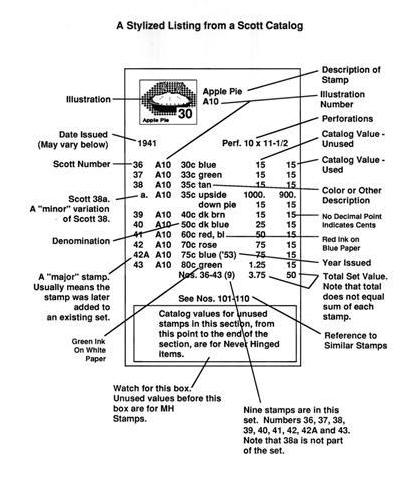
The next few sections contain word descriptions of things you will find in a Scott Catalogue. At the end of the chapter is a sample listing from a catalog. By looking at the sample, you will better understand the text. |
22.2 How stamps are organized in the Scott Catalog
First you have to find the country you want. After that, all stamps for that country are organized and numbered in exactly the same order:
Regular stamps (Commemoratives and definitives): 1, 2, 3, 4...
Semi-postal stamps: B1, B2, B3, B4...
Airmail stamps: C1, C2, C3, C4...
Special delivery stamps: E1, E2, E3, E4...
Registration stamps: F1, F2, F3, F4...
Official stamps: O1, O2, O3, O4...
Revenue stamps: R1, R2, R3, R4...
Duck stamps: RW1, RW2, RW3, RW4...
There are a lot of other one- or two-letter prefixes, but the ones above are the most common ones. Note that revenue stamps have many different types and can have R, RA, RW and other prefixes. Note, also, that the Scott numbers are more or less in the order the stamps were issued. The C1 is the first air-mail stamp issued, C2 is the second, etc.
You may also see suffixes on the end of a stamp number. A little letter (a, b, c...) means a variation of the stamp. For example, USA C3 is a Jenny air-mail stamp with the airplane printed properly. C3a is the same stamp with the airplane printed upside down. You may also see this with se-tenants. Four stamps individually may be numbered 3001, 3002, 3003 and 3004. The 3004a may be the block of four all attached together. You may also see this the other way around, too. The 3020 may be the block of four and 3020a, 3020b, 3020c and 3020d may be the individual stamps.
A capital letter at the end (A, B, C...) usually means an entirely new stamp. Suppose a government issues four stamps, and Scott numbers them 11, 12, 13 and 14. Each has a value of 1 cent, 2 cents, 3 cents and 5 cents, respectively. Ten years later, the government decides to issue a 4-cent stamp in the same design. Scott has three choices (and they use all three of them). They can either:
a. give the new stamp number 13A and leave the other numbers alone,
b. give the new stamp the next available number, say 862 or,
c. renumber a whole bunch of stamps so all five stamps fit together
properly.
You may encounter a situation where a stamp in an album is marked Scott number 1234. When you look in the Scott catalog, stamp 1234 may be totally different. There is a list of catalog number changes in the back of each volume; however, it only lists one year’s changes. If the change occurred twenty years ago, you have no choice but to look around to see if you can find the new number. Sorry about that!
22.3 Pictures of stamps
Scott shows a lot of pictures of stamps, but does not have a picture of every stamp. If you are looking at regular stamps (numbers 1, 2, 3, 4, etc.), each one will have a reference to a picture number. For regular stamps, a picture number starts with the letter A.
You may see a listing that looks like this: 2446 A741
That means stamp number 2446 is illustrated in picture number A741. The pictures appear in numerical order starting with A1 and continue upward. The picture is normally just above where the stamp is listed, and it always has a picture number to the left or right of it; however, it is possible that a picture may be several pages back. Just flip back until you find the proper picture.
Semi-postals, airmail, and other kinds of stamps use a different prefix (instead of an “A”) on their pictures. Once you grasp the concept that a picture number and a catalog stamp number are different, it is easy to go from the catalog number to the picture.
There is one problem with all of this, however. There is not a picture of every stamp listed in the catalog. In a set of ten stamps with different face values, for example, all ten stamps may be referenced to only one picture. One will match the picture exactly, but the others will only be similar to the picture. (Usually the difference is just the denomination of the stamp.) If you have a stamp in hand, this sometimes causes a problem in trying to find its picture in the catalog. (This is one reason collectors do not like broken sets!) If you have a set of stamps in hand, most likely you will find a picture of the one with the lowest denomination.
22.4 Miscellaneous information about the stamp
Just above the listing for each stamp, or set of stamps, is a header that contains miscellaneous information about the stamp. This might look like this:
1988, March 1 Litho. Perf. 12-1/2 x 11
The first part is the date the stamp was issued (the first day of issue). The “litho.” part means the stamp was printed using lithography. (This is usually not an important fact to you.) The final part is information about perforations. In this case, the stamp is perforated 12-1/2 x 11.
On some stamps, mostly older ones, knowing the stamp’s perforation measurements is important. It could mean the difference between a 15-cent stamp and a $1,000 stamp. If you look at several different stamps, you may notice that the spacing between the perforation holes is different. Some are closer together, and some are farther apart. At times, governments will issue the same stamp design, but they would perforate them differently. As far as collectors and the Scott catalog are concerned, you now have two different stamp numbers.
If you want to measure the perforations on a stamp, you need to get a perforation gauge. These cost about $7. See chapter 25 for how to order one. A perforation gauge is a piece of plastic or heavy paper with lines printed on it. Match the lines to the holes, and you can read how a stamp is perforated. It comes with instructions, so don’t panic!
What “perf. 12-1/2” actually means is that there are 12-1/2 perforation holes in a 2-centimeter-long area. Now do you know why you need the gauge? If you see “perf 12-1/2” by itself, it means the stamp is perforated the same on all four sides.
“Perf. 12-1/2 x 11” means the stamp is perforated 12-1/2 on the top and bottom of the stamp, but perforated 11 on the left and right sides. There are 12-1/2 holes in 2 centimeters along the top and bottom, and there are 11 holes in 2 centimeters along the left and right sides.
There are even a few stamps that are perforated differently on three or four sides. If you ever find one of these, I will leave it to you to read the entire section on perforations in the introduction section of each Scott catalog.
22.5 Catalog Values
A typical listing for a stamp might look like this:
637 A105 2p black, bluish 1000. 20
Here is what this means:
The Scott number is 637.
The picture of this stamp is A105.
The stamp has a denomination of 2 pence.
The stamp is printed with black ink on bluish paper.
A mint stamp has a catalog value of $1,000 in F-VF condition.
A used stamp has a catalog value of 20 cents in F-VF condition.
Here are some important notes:
1. If you don’t see a decimal point, it means cents.
2. If you do see a decimal point, it means dollars. You may or may not see cents after the decimal point (e.g., 2.50 = $2.50; 1000. = $1,000.00).
3. If the used price is in italics, it means the stamp is more valuable used than mint. This implies that very few of the stamps were actually used to mail letters. Normally, you would need a stamp tied to a cover with a visible postmark date. The date must be around the time the stamp would have been in use for postal purposes. Sometimes experts can also establish that the stamp was properly used without having a dated postmark. See chapter 23 on stamp expertization.
4. The minimum price for any stamp is twenty cents. This is the price a dealer “should” be selling the stamp for. It takes into account that his/her time is expensive and that preparation for selling a common stamp costs money, too.
5. Just because a stamp dealer sells a stamp for twenty cents does not mean you can sell it for twenty cents.
6. Just because a stamp has a $100 catalog value, does not mean you can sell it for $100. You are more likely to end up with $25 or so.
7. On sets of stamps with five or more stamps, Scott’s conveniently totals the columns for you. If it’s four or less stamps, you must add them up yourself to get the total set value. An exception is if a set has ten 20-cent stamps in it, they may give you a total indicating the set is worth less than $2.00. The reason behind this is the dealer does not have to do 10 x 20-cents worth of work to sell the complete set.
| Newer Sets in
Scott’s May Not List Prices for Individual Stamps A new pricing situation has occurred beginning with the 1996 Scott catalogs. In order to save space, Scott is no longer listing prices for individual stamps in newer sets of some countries. Instead they only list the price of the entire set. The assumption here is that most dealers would only be selling a complete set. You may, however, have only one stamp from the set and may need a price. As an example, let’s assume the set consists of four stamps. The stamps have face values of 10d, 20d, 30d and 40d. The total set is priced at $10 in Scott’s. You have only the 40d stamp and need a price. Here is how you can estimate it. 1. Add up the face values of all the stamps in the set. 10d + 20d + 30d + 40d = 100d 2. Divide the face value of the stamp you have by the total in step 1. 40d/100d = 0.40 3. Multiply the value in step 2 by the total catalog value of the set. 0.40 x $10 = $4. Your stamp therefore has an approximate SCV of $4. |
8. Somewhere in the country listing, you will see a note like this:
Catalog values for unused stamps in this country are for Never Hinged items, beginning with Scott 772 in the regular postage section, Scott C19 in the air post section....
What does that mean? In this case, the prices for #1 through #771 are for MH stamps. The prices for #772 and upward are for MNH stamps. The price for C1 to C18 are for MH stamps, and the price for C19 and upward are for MNH stamps.
So what happens if you have #500 that is MNH? How much is it worth? Well, this can be a dilemma. Sometimes Scott’s will list a note on the next line that says, “Never Hinged,” and then a price. That was easy. But, sometimes they don’t, and you have to guess! You can spend years researching what the price should be, but you may never come up with the right answer. It varies by country, and it’s based on hundreds of ill defined factors. If you need to have a number, just add 25% to the price listed. That should be relatively close on average.
What happens if you have stamp #1000 with a mint value of $1.00, but your stamp is hinged? This is the same problem, but it’s in reverse. On average, take 25% off the price. In this case, the catalog value will become 75 cents.
Another thing may happen. The used price is in italics, and it’s more than the mint price; however, your used stamp does not have a clear date postmark on it. Again you’ll have to guess. I usually guess 75% of the mint price is the catalog value for this particular stamp.
You may run into this problem: you have a stamp issued in 2005, and the catalog stops with the 2004 stamps. How do you price the 2005 stamp? You have a couple of choices. First, wait a year or two until a new catalog is published, or second, guess! Guessing is actually not that difficult. Simply try to find a similar kind of stamp with the same denomination in the catalog you have. Chances are the new stamp will have a catalog value equivalent to the similar stamp.
If you are planning to buy a set of Scott catalogs, it is sometimes best to wait at least two years after you inherit the collection. If the person who collected the stamps were actively acquiring new stamps in his/her later years, most of the stamps will be in the catalog you buy.
CAUTION: If you find a stamp in the catalog and it has an unusually high catalog value, check the notes above and below the stamp listing. There is a good chance there are other, similar stamps to the one you have, and that the stamp you really have is less valuable. Here is a trick: Look at the picture number of the stamp you found, then scan back in the listings until you find the first time the picture number is associated with a stamp. Next, look under that stamp’s listing to see if there is a note referring you to some other stamp number(s). Look at those numbers and see if you have one of those stamps instead. The “see other stamp” message usually only appears under the stamp with the earliest issue date.
| What do you do about watermarks? Sometimes you will see two stamps that are the same except one has a watermark. One is really valuable, and one is not. Unless you know that the person who collected the stamps usually bought expensive stamps, the chances are good that you have the lower-value stamp rather than the high-value one. You can have the stamp expertised (see chapter 23), but that’s going to cost you $20 or more. This same condition applies to stamps which have minor variations. You will see notes such as, “type II stamps have thicker lines on the inside of the [person’s] left ear.” Even with a magnifying glass, you can’t really tell. Statistically, you probably have the lower-value stamp. |
In conclusion, the Scott catalog is not the easiest book in the world to use; however, if you want to identify and value stamps, and you live in the USA, you have to use it since it’s about the only stamp catalog used in the USA. Your first inclination may be to fling it through the window; however, the more you use it, the easier it will become. In defense of Scott, the stamp-printing agencies of the world do not make life easy for any of us.
Once you actually get a copy of the catalog, look through it and study the front and back of each volume. There is a lot of helpful information.

